


It is not an easy life even for someone like Dravid, whose touch points with cricket spread across decades, formats and varied roles.

Esports to breakdancing, Hangzhou will set the trend for future of sport

When the Pakistan innings ended, there were 1.1 crore viewers live on the app and this increased to 1.4 crore viewers during the innings break.

Automotive (auto) and auto ancillary stocks have been in the fast lane thus far in 2023-24 (FY24), with the National Stock Exchange Nifty Auto Index surging nearly 27 per cent, outperforming the Nifty50, which has gained roughly 11 per cent during this period. The top-gear performance of auto stocks at the bourses, according to A K Prabhakar, head of research at IDBI Capital, has been triggered by the premiumisation of products across vehicle manufacturers, which has seen vehicle sales remaining relatively stable. "It is not about higher sales figures now, but about premiumisation.

Brand India's societal divisions and distortions have remained as much relevant in 'liberal' America and Europe as it still is in the structurally stratified Indian society of the 21st century, observes N Sathiya Moorthy.

'The last year's growth is a foretaste of things to come in the retail credit market.'

From crisis leaders to future Goliaths, India Inc saw them all in 2017, says Shailesh Dobhal.

"We will do anything to keep the BJP out of power...In the interest of Karnataka, my father should become the chief minister," Yathindra Siddaramaiah said.

The Gujarati's intolerance for diversity can be seen in India's hard nationalism which is showing itself in Kashmir and the North East, observes Aakar Patel.

'I somehow felt that Muzaffar Ali was in Aligarh to feel the pulse of the Muslim youth, especially in the darker and harsher times that India is passing through,' notes Mohammad Sajjad.
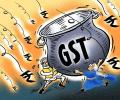
GST collection rose 11 per cent to over Rs 1.65 lakh crore in July as a result of anti-evasion measures and higher consumer spending. This is the fifth time since the rollout of the Goods and Services Tax (GST) regime that monthly collections have crossed the Rs 1.60 lakh crore mark -- making it the new normal. "Gross GST revenue collected in July is Rs 1,65,105 crore of which CGST is Rs 29,773 crore, SGST is Rs 37,623 crore, IGST is Rs 85,930 crore (including Rs 41,239 crore collected on import of goods) and cess is Rs 11,779 crore (including Rs 840 crore collected on import of goods)," the finance ministry said in a statement.

Flipkart, the e-commerce company owned by Walmart, is intensifying its efforts to achieve profitability as it is eyeing a valuation of approximately $60 billion at the time of its initial public offering (IPO), now planned in 2025-2026, instead of this year, according to people familiar with the matter. The firm might consider listing in the US or any other geography, including India. The company, which counts the likes of Amazon and Reliance's JioMart among its competitors in India's burgeoning e-commerce market, had also contemplated launching an IPO in 2022-2023.

'Just the amount of work which is there just to become more and more successful in banking. For this to happen you need to have leaders who understand technology.'

'As the Indian economy continues to expand over the next three years, mid- and small-caps should do well as they have higher exposure to the domestic economy than large-caps.'

India remains a young nation, but it will not get younger in future. India has not managed to noticeably improve education. Nor has it managed to create employment opportunities, observes Devangshu Datta.

'As long as businesses do not consider cyber recovery an integral part of their enterprise IT, they remain greatly vulnerable.'

The country's Fast-moving consumer goods (FMCG) industry witnessed a consumption slowdown in the December quarter, with an overall "negative" volume growth, as consumers continue to reel under inflationary pressure, says a report. According to the report released by data analytics firm NielsenIQ on Thursday, in October-December, the FMCG industry grew 7.6 per cent in terms of value but its volume growth was (-) 0.3 per cent. "... Overall FMCG volume growth is negative, the absolute values, as well as volumes, continue to be above pre-Covid levels across markets," it said.

About 60 per cent of Indian private insurers believe there has been a significant rise in insurance-related frauds, and as risks lurk there is an immediate need to consider a proactive fraud risk management framework, a Deloitte survey said on Thursday. Insurance companies in India have experienced a rise in fraud instances in life and health insurance, and increased digitisation, remote working post pandemic and weakened controls are key factors contributing to frauds, according to Deloitte's Insurance Fraud Survey 2023. "About 60 per cent of survey respondents believe that there has been a significant rise in fraud, while further 10 per cent experienced a marginal increase," the survey said.

The Colgate-Palmolive (India) stock gained 2.3 per cent in trade on Friday, and ended at Rs 2,079 per share. This was on the back of a robust operating performance in the July-September quarter of 2023-24 (Q2FY24) and expectations of gradual sales recovery going ahead. While the stock is up 44 per cent from its lows in January this year, further gains will depend on its ability to sustain higher growth rates.

While Virat Kohli is the face of that trend-setting move, Basu Shanker, the strength and conditioning coach of Royal Challengers Bangalore, has been a silent catalyst.

'If the South starts shooting on IMAX more, it will be beneficial. And likewise, it will benefit Bollywood directors.'

'The risk is in not being invested and missing out on an upmove.'

After a brief lull during the pandemic, there is a strong revival in luxury car sales, bolstered by more launches across price bands, replacement demand, ban on old diesel vehicles in the NCR, and 'revenge buying'.

According to the report, Naukri Job Speak Index stood at 1,600 for May 2014, a stable hiring scenario compared to the previous month.

As employers eye quality talent, employees will enjoy an upper hand in demanding high pay, better benefits, remote work options and other perks, predicts Navneet Singh, CEO, Avsar, a talent management firm.

eCommerce major eBay India released its 'Battle Of The Gadgets' report for the months of April May and June. Here's what you purchased online

"It will not cause another surge. BA.2 is not capable of infecting people who had BA.1. It's not a new virus or strain. BA.2 is a sub-lineage of Omicron," Dr Jayadevan said.

Congress sitting MLA Saleh Mohammad, is hoping to buck the trend of anti-incumbency in the seat, and believes people will vote for his development work and not along religious lines.

'...similar to the 2008 global financial crisis, the 2012 taper tantrum, or the 2018 midcap crash.' 'This could lead to a substantial decline in activity and revenues for the broking industry.' 'When this will happen is uncertain, but as brokers, we must be prepared for such a downturn.'

Omicron has started replacing Delta variant in the country in terms of the number of COVID-19 cases and positive international travellers are almost 80 per cent Omicron now, official sources said on Friday.

India's mutual fund (MF) industry had barely any retail footprint when it completed 50 years in 2013. MFs had Rs 7 trillion in assets under management (AUM) in March 2013, of which around Rs 5 trillion was in institution-focused debt funds. By comparison, bank deposits in the country stood at Rs 67.5 trillion around the same time.

Domestically, Indians are exploring popular beach destinations, the hills of Himachal Pradesh and Uttarakhand, and the North-Eastern region as well.

'The market should maintain optimism on the back of range-bound oil prices, a robust fiscal balance sheet, a better-than-expected monsoon, and moderating inflation.'

Rediff Labs has created a chart to analyse the trend of COVID-19 cases across the country since the first case was reported on January 30, 2020.

Salary increments in India will touch a five-year high of 9.9 per cent in 2022 as organisations are planning to invest in new-age capabilities to build a resilient workforce amid strong economic recovery and positive business sentiment, a survey said on Wednesday. According to leading global professional services firm Aon's 26th Salary Increase Survey in India, organizations across industries project a 9.9 per cent salary increase in 2022, compared to 9.3 per cent in 2021. The study that analysed data across 1,500 companies from more than 40 industries, noted that the industries with the highest projected salary increases are e-commerce and venture capital, hitech/IT and IT enabled services (ITeS) and life sciences.

Billionaire Mukesh Ambani's four-year-old telecom venture Reliance Jio has been ranked the fifth strongest brand globally behind the likes of Ferrari and Coca-Cola. The Brand Finance's Global 500 ranking of the strongest brands globally, which determined the relative strength of brands, is topped by WeChat, according to its annual report on most valuable and strongest global brands.

Cement companies posted mixed figures for the first quarter of the 2023-24 financial year (Q1FY24). Volume growth was robust at 17 per cent year-on-year (Y-o-Y) - on an aggregate basis - for 15 cement companies, with revenue growth at 15 per cent. Aggregate earnings before interest, taxes, depreciation, and amortisation (Ebitda) were up 8.8 per cent Y-o-Y and 1.2 per cent quarter-on-quarter (Q-o-Q).

The year ahead will be all about making a personal style statement with some help from designers
 © 2026 Rediff.com - Advertise with us - Disclaimer - Privacy Policy - Sitemap - Feedback - About us - Terms of use - Grievances